AD 71 to today
The history of York
A Roman fortress, a Viking trading capital, and home to one of the largest Gothic cathedrals in Europe.
York began life in AD 71 as a Roman fortress named Eboracum, built to control the north of Britain. It grew to become one of the most important cities in Roman Britain, serving for a time as the de facto capital of the northern part of the empire. Its imperial significance is underlined by the fact that the Roman Emperor Constantius I died there in AD 306, an event that led directly to his son, Constantine the Great, being proclaimed emperor on the spot, one of the pivotal moments in the transition of the Roman Empire towards Christianity.
After the Romans withdrew, the city eventually fell to Viking invaders in 866, who renamed it Jorvik and transformed it into a major trading hub with connections stretching across the Viking world, from Scandinavia to the Middle East. Archaeological excavations in the city, most famously at Coppergate, uncovered extraordinarily well-preserved remains of this Viking settlement, now displayed at the JORVIK Viking Centre.
The city's medieval character, still so visible today, developed over the following centuries as York grew into a major ecclesiastical and trading centre. Its city walls, largely intact and walkable today, are the most complete in England. At the city's heart, York Minster was built over more than two and a half centuries, from the early 13th century through to the mid-15th, becoming one of the largest Gothic cathedrals in northern Europe and the seat of the Archbishop of York, second only to Canterbury in the Church of England's hierarchy.
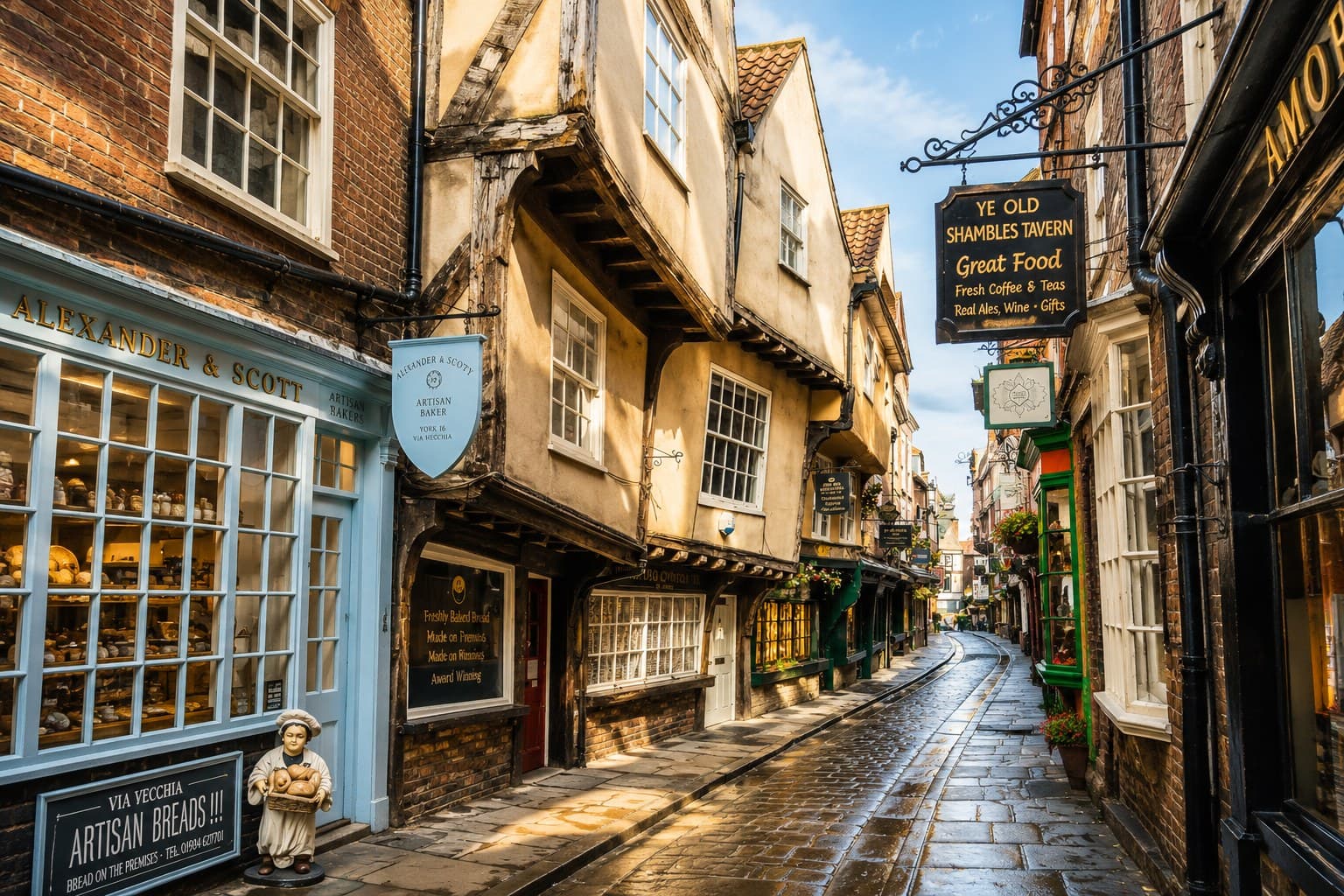
The narrow medieval street known as the Shambles, with its overhanging timber-framed buildings dating back centuries, survives much as it would have looked in medieval times and remains one of the best-preserved medieval streets anywhere in Europe. Together, the Roman walls, Viking heritage and Gothic Minster give York a continuous, layered history stretching back nearly two thousand years, almost uniquely visible and walkable within a single compact city centre.
SEE IT FOR YOURSELF
This history comes alive on the ground. Plan a visit with opening times, directions and what to see.