1699 to today
The history of Castle Howard
A playwright's first building commission became one of the grandest private houses in England.
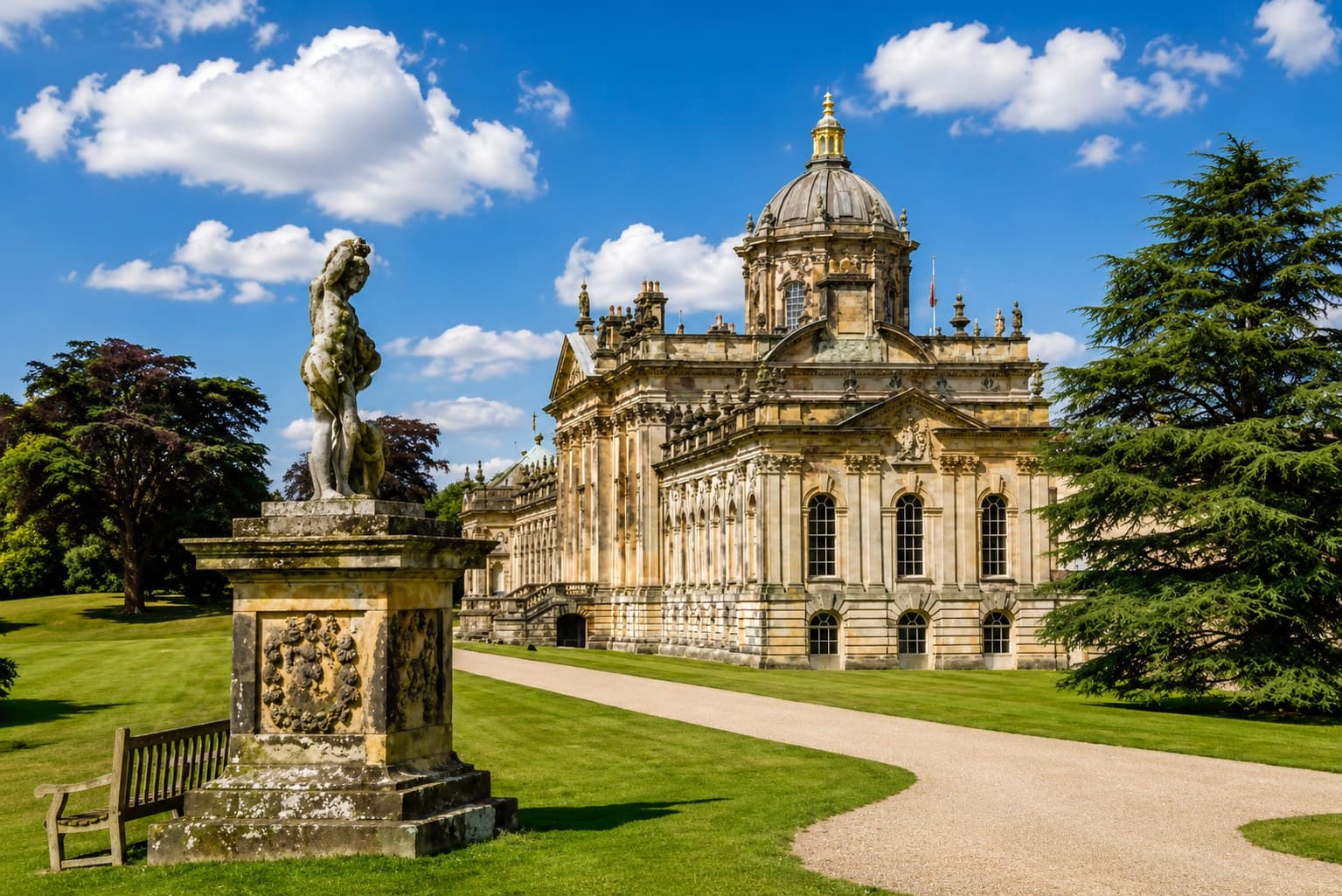
Castle Howard is not, despite its name, a castle at all, but a vast country house built from 1699 for Charles Howard, the 3rd Earl of Carlisle. Its design is remarkable for an unusual reason: the architect, Sir John Vanbrugh, was at the time better known as a successful playwright with no formal architectural training. Vanbrugh worked alongside Nicholas Hawksmoor, an experienced architect who had trained under Sir Christopher Wren, and together they created one of the first and grandest examples of English Baroque architecture, a dramatic departure from the more restrained classical style fashionable at the time.
Construction continued for well over a century, eventually creating the sweeping house, lake, and parkland visitors see today, dotted with garden buildings including the Temple of the Four Winds and Hawksmoor's strikingly austere Mausoleum, built to house the remains of the Howard family. The house has remained in the same family's hands ever since it was built, now run by their descendants, making it one of the longest continuously family-owned great houses in England.
The house's most distinctive feature, its central dome, was largely destroyed by a catastrophic fire in 1940 and was not fully restored until decades later, a restoration that became a defining project for the family in the second half of the 20th century. Its grandeur and slightly theatrical quality, fitting given its playwright-architect, made it a natural choice as the filming location for both the 1981 television adaptation and the 2008 film of Evelyn Waugh's novel Brideshead Revisited, a connection that introduced the house to a vastly wider audience and remains part of its identity today.
SEE IT FOR YOURSELF
This history comes alive on the ground. Plan a visit with opening times, directions and what to see.