1154 to today
The history of Bolton Abbey
Not actually an abbey, but an Augustinian priory that survived the Dissolution as a parish church, on an estate still owned by the same family.
Despite its name, Bolton Abbey was never technically an abbey at all. It was founded in 1154 as a priory of Augustinian canons, a different religious order from the Cistercians of Fountains, Rievaulx and Jervaulx, and was originally established a few miles away at Embsay before moving to its current beautiful position beside the River Wharfe shortly afterwards, on land gifted by the powerful de Romille family.
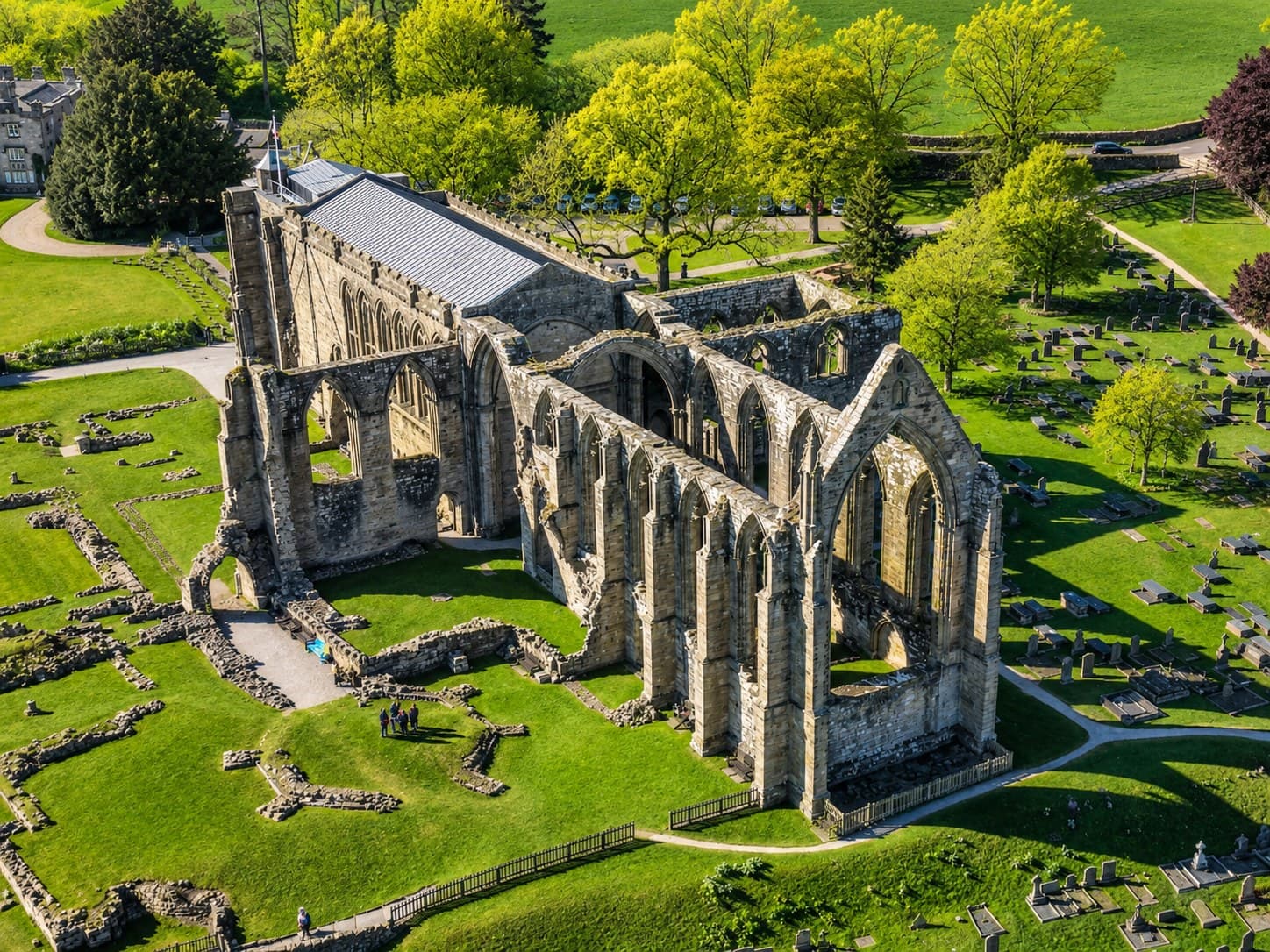
The priory thrived for nearly four centuries on the rich farmland of Wharfedale, its canons living a less austere life than the Cistercians while still running substantial estates. When the Dissolution reached Bolton in 1539, something unusual happened: the local community had already been using the priory's nave as their parish church, and rather than letting the whole building fall into ruin, they were permitted to keep that section in use. It remains a working parish church today, while the rest of the priory buildings, the chancel, the cloisters and the monastic quarters, were stripped and left as the ruins visitors see now.
After the Dissolution the estate passed through the Clifford family before eventually coming to the Cavendish family, the Dukes of Devonshire, who still own and manage the Bolton Abbey estate today, more than four hundred years later. That long continuity of ownership is part of why the estate feels so well kept, with miles of waymarked walks, stepping stones across the Wharfe, and the notorious Strid, a narrow, violently fast stretch of the river that has claimed lives over the centuries and become a dark local legend in its own right.
The dramatic scenery around Bolton Abbey also drew the attention of Romantic-era artists and writers. J.M.W. Turner painted the priory ruins more than once, and William Wordsworth used the legend of the Strid and the "White Doe" of nearby Rylstone as the basis for one of his narrative poems, helping cement Bolton Abbey's reputation as one of the most romantic ruined sites in Yorkshire.
SEE IT FOR YOURSELF
This history comes alive on the ground. Plan a visit with opening times, directions and what to see.